
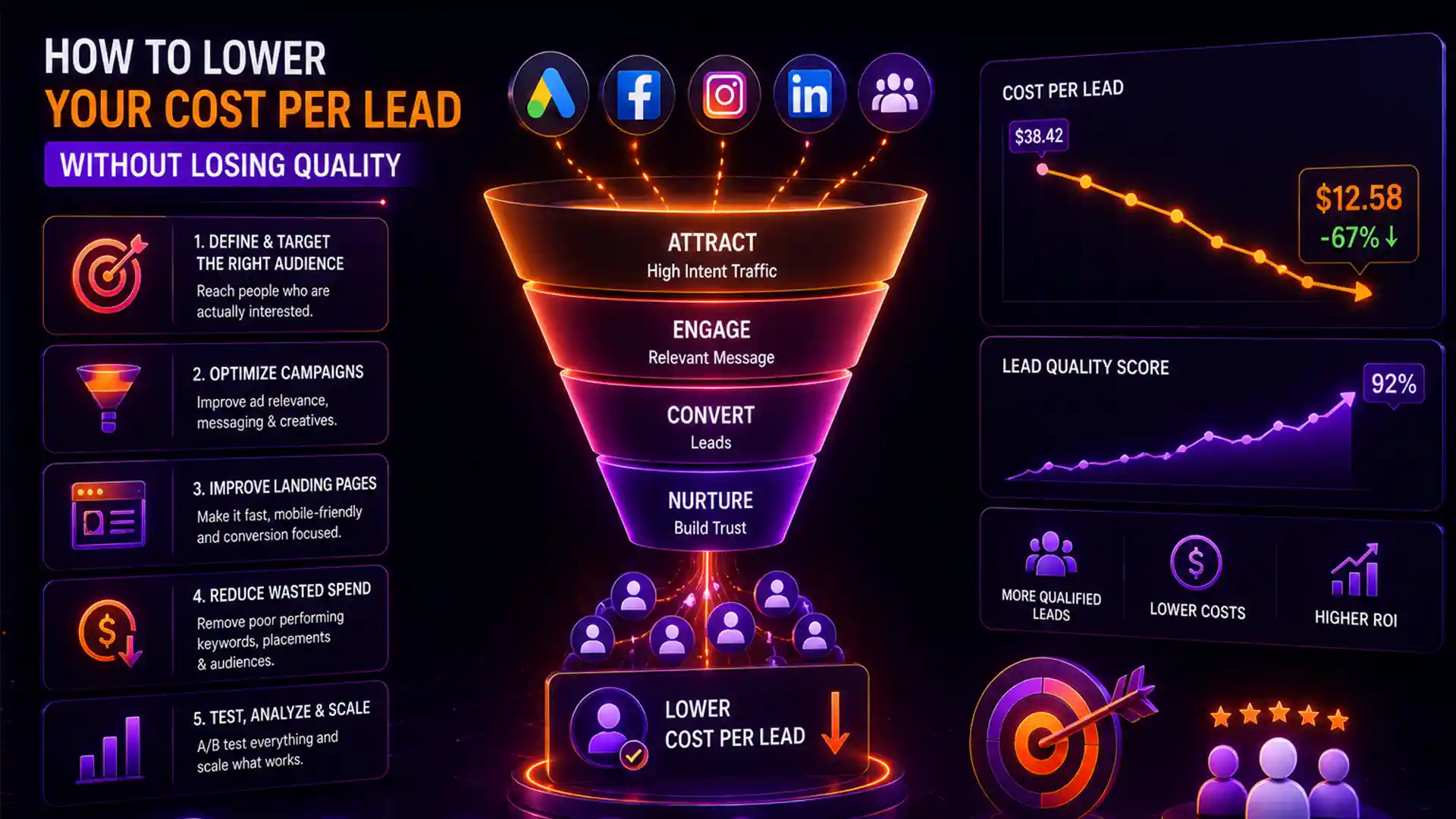
Rising cost per lead is usually blamed on "the platform getting more expensive" - but in most accounts, the real cause is wasted spend on the wrong clicks, not the auction itself. Fix targeting and landing pages first, and cost per lead usually drops without sacrificing lead quality.
WHAT'S IN THIS GUIDE
Why Cost Per Lead Creeps Up Over Time
Campaigns naturally accumulate waste as they run - broad match keywords pick up irrelevant search terms, audiences drift, and ad copy that performed well at launch becomes stale. Left unmanaged, this waste compounds, and cost per lead quietly climbs even if your core offer and market haven't changed.
Targeting Fixes
Targeting Checklist
Start Here- ✓Review your search terms report weekly and add irrelevant queries as negative keywords
- ✓Narrow broad match keywords that are pulling in unrelated searches
- ✓Exclude locations outside your actual service area
- ✓Adjust device bid modifiers if one device converts poorly
- ✓Layer in audience exclusions for existing customers, if not remarketing
Landing Page Fixes
A cheap click that lands on a slow, confusing, or irrelevant page is more expensive than a slightly pricier click that converts. Landing page relevance directly affects both conversion rate and Quality Score, which lowers your cost per click too.
Landing Page Checklist
High Impact- ✓Match the landing page headline to the ad copy that brought the click
- ✓Keep the form short - name, phone, and one qualifying question is often enough
- ✓Make sure the page loads in under 3 seconds on mobile
- ✓Remove navigation links that let visitors wander off before converting
- ✓Add a visible phone number for immediate call conversions
Quality Score & Ad Relevance
Google Ads rewards tightly themed ad groups - where the keyword, ad copy, and landing page all closely match - with a lower cost per click. Loosely grouped campaigns with generic ad copy pay more for the same position.
- Split large ad groups into smaller, tightly themed groups around a single concept.
- Write ad copy that mirrors your top keywords rather than generic brand messaging.
- Test 3-4 ad variations per group and pause underperformers regularly.
The Tempting Fix That Usually Backfires
| Approach | Short-Term Effect | Long-Term Effect |
|---|---|---|
| Cut budget across the board | Lower spend | Fewer leads, no efficiency gain |
| Lower max bids | Cheaper clicks | Lost auctions, less volume |
| Fix targeting & landing page | Slower to implement | Lower cost per lead, same or better volume |
A Quick Weekly Audit Routine
- Check the search terms report for irrelevant queries and add negative keywords.
- Review device and location performance for any segment quietly wasting spend.
- Confirm conversion tracking is firing correctly - inaccurate tracking makes every other decision unreliable.
- Pause the lowest-performing ad in each group and test a new variation.
Frequently Asked Questions
What is a good cost per lead for small businesses?
It varies significantly by industry and average customer value, but a good cost per lead is one where your cost to acquire a customer, including close rate, still leaves a healthy profit margin.
Will lowering cost per lead reduce lead quality?
Not if done correctly. Cutting wasted spend on irrelevant clicks and improving targeting typically improves both cost per lead and lead quality at the same time, since you're removing the wrong audience rather than the right one.
Should I pause my campaign if cost per lead suddenly increases?
Not immediately. First check for external causes (seasonality, increased competition, landing page issues) before pausing, since a short data gap can slow down the campaign's learning phase.
How often should I review negative keywords?
Review your search terms report at least every 1-2 weeks for active campaigns, adding irrelevant queries to your negative keyword list as they appear.